Specialty coffee, curated

Real specialty coffee, vetted by real coffee people.

Every shop in Bloom is scored against an eligibility rubric and approved by a human curator before it appears on the map. No bean-to-cup machines. No 4.7-star breakfast spots dressed as cafés.

iPhone, iOS 26+ Reviewed by curators, not stars
Why Bloom

Editorial taxonomy, not algorithmic averages.

A 4.7-star rating is an opinion about the ham-and-egg breakfast. A rubric is an opinion about the coffee.

Google Maps' star rating doesn't tell you whether a shop pulls light-roast espresso, brews single-origin pour-over, or works with a specific roaster. It tells you how the breakfast crowd felt about the avocado toast.

Bloom uses a third-wave rubric (manual espresso, named or in-house roaster, coffee-first focus, transparent sourcing) to decide what counts. A submission has to pass the rubric before a curator even sees it. Then a curator decides if it's in.
What you get

Built for people who care who roasted the beans.

The four parts of Bloom.

  1. A curated map

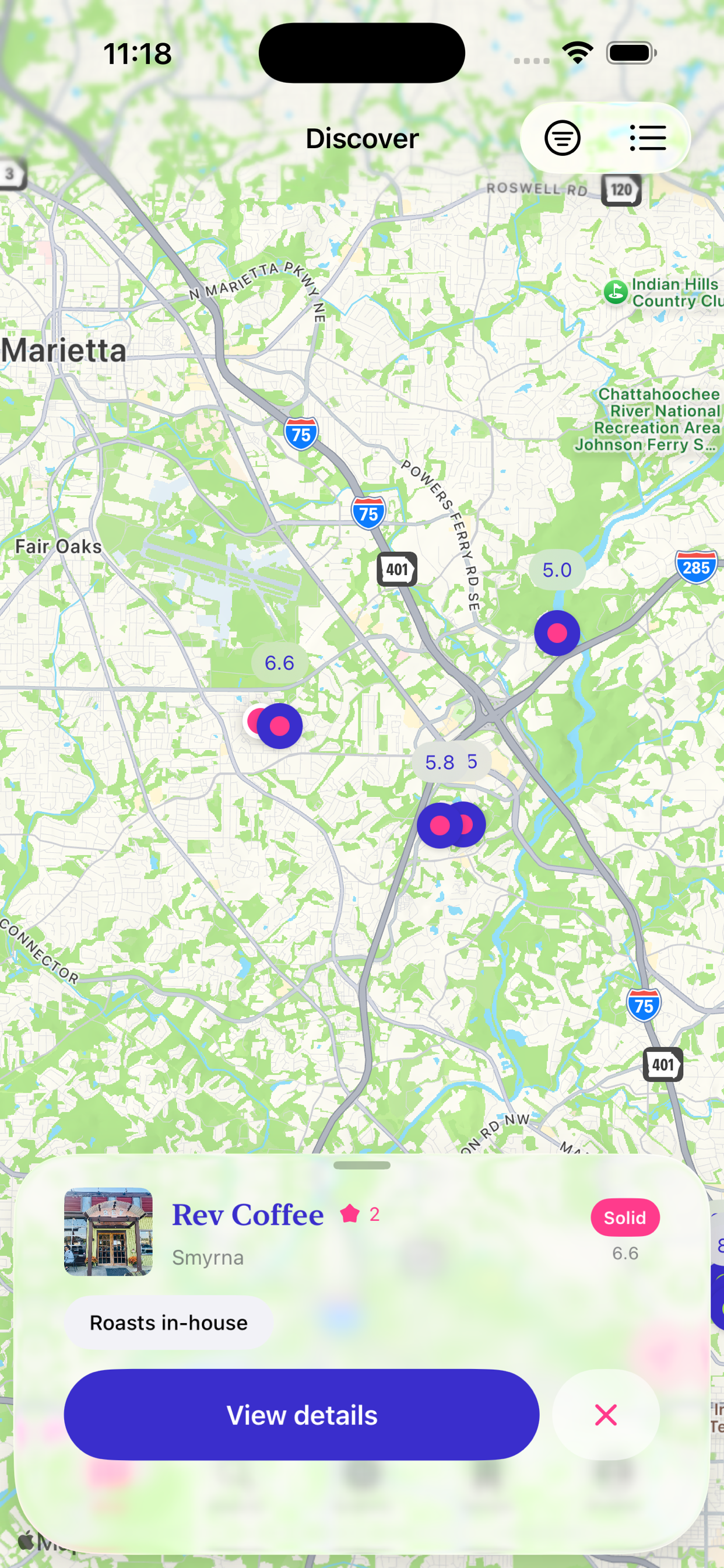
    One pin style. Every shop on the map has been reviewed by a curator. Filter by pour-over, single origin, in-house roasting, rotating roasters, specialty decaf.

  2. A real rubric

    Hard requirements, auto-disqualifiers, and a 0 to 10 score (we call it the Specialty Score). Approved shops carry their score. The criteria are public and consistent.

  3. A community signal, with bounds

    The Bloom Score is a count of community Blooms on shops people have visited. It runs alongside the editorial score, not on top of it. Popularity does not override the rubric.

  4. Plan ahead, save offline

    Search by city, country, or roaster before a trip. Save shops to a list that works offline. Saved details and photos sync to your device.

The people behind the map

Curators.

What a curator is

A curator is the human reviewer who decides whether a submitted shop lands on Bloom. The eligibility quiz filters out the obvious misses; the curator does the harder work of judging fit, looking at the photos, reading the answers, and saying yes or no.

How curation works

Two layers, both visible. The rubric runs first: hard requirements, auto-disqualifiers, and a 0 to 10 score that lives in code so the criteria don't drift between shops. The curator runs second, and decides whether the rubric got it right. The rubric is open. So is the list of curators.

Curator, super-curator, editorial challenge

Curators review submissions in their city. Super-curators handle escalations, cross-city decisions, and "Wrong for Bloom" challenges from the community. Editorial challenges let super-curators retire shops that no longer fit, and surface ones the rubric undersold. It's peer review with a paper trail, not a single editor's opinion.

How to become a curator

Curation is invitation-only and city-by-city. New cities open when a curator there is in place. If you'd like to volunteer for your city, email [email protected] with where you are and a couple of shops you'd vouch for.

Launch curators

Atlanta. Stefan Bekker.
Paris. Jan.

Two cities, two humans. More follow as new regions open.

Submit a shop

Know a shop that should be in Bloom?

Submitting takes a few minutes. The eligibility quiz runs first. If a shop passes the rubric and a curator agrees, it's in. If not, you'll see why.

Submit in the app
Read this first

Common questions.

How does Bloom decide what counts as specialty?

The rubric is the in-app quiz. It runs against the same questions and weights for every submission, and the answers live in code so the criteria don't drift between shops. Required: manual espresso, a named or in-house roaster, transparent sourcing, and a coffee-first focus.

Why did my submission get rejected?

The eligibility quiz runs before a curator sees the shop. A bean-to-cup espresso machine is an automatic kill. Below-threshold scores get a generic rejection that the shop doesn't fit Bloom's third-wave focus. The threshold and the computed score are not shown to submitters; that's intentional, so the rubric isn't gamed by reverse-engineering.

What is "Wrong for Bloom"?

If a shop is on the map and you think it doesn't fit the third-wave rubric, open it and tap Wrong for Bloom. You make the case in writing; a super-curator reads it and decides whether to retire the shop or leave it. There are no downvotes; the way to challenge a shop's place is by argument, not by clicking a button.

How do I become a curator?

Curators are invited city-by-city as Bloom opens new regions. The role is invitation-only today. If you'd like to curate your city, email support and tell us where you are and a couple of shops you'd vouch for.

What's the difference between Specialty Score and Bloom Score?

Specialty Score is editorial: the rubric output, 0 to 10 with one decimal. Bloom Score is community sentiment, the count of people who have Bloomed the shop. They sit next to each other on the shop card; the community score never overrides the rubric.

Where is Bloom available?

Metro Atlanta and Paris open first. Atlanta launches with 14 curated shops across downtown, the Westside, Toco Hill, Smyrna, Dunwoody, and Cartersville. Paris arrives once its curator's set is in. New cities open as curators come online.

Does Bloom track me or sell my data?

No tracking, no ads, no third-party analytics. The only data Bloom holds is what you give it: an account email, shops you submit, shops you've Bloomed, photos you upload, and shops you save. The privacy page has the full nutrition label.

Will there be an Android version?

No. Bloom is iOS-first and stays there. iPhone, iOS 26 and later.

Get Bloom

Available on iOS.

iPhone, iOS 26 and later. The Android version is not on the roadmap.

Download on the App Store

Free. No ads, no trackers, no subscription tier.